Showing posts with label Film Review. Show all posts

Sunday, May 31, 2009

My review of UP


I am a sucker for Pixar movies. I was first introduced to their short films when I was a film student at the University of Utah. From the simplicity of Luxor Jr. to the madcap slapstick in Knick Knack, I knew the filmmakers at Pixar were doing something special. From the simple friendship of Buzz and Woody, to the story of two robots falling in love, I have enjoyed all of Pixar's films. I can't choose a favorite, how can you? I can say that CARS and A Bugs Life are my two least favorites, but a lesser Pixar film is better than 95% than other films, and I include live action as well as animated films in that equation.

With UP though, we have  a movie about a man grieving over his dead wife and learning to overcome that grief and find new adventures to live.  As much as I love the first Toy Story, we've come a really long way in storytelling from toys that come to life when no one is around and talking bugs striving to save their colony.  That's what I love about Pixar, they are constantly progressing, always pushing new stories, new emotions and new ways to share those human emotions with their audience.

The thing that sets Pixar apart from so many studios, is that they dare. They risk. They don't listen to focus groups about marketing potential, they just tell stories. They made a film about a rat who wants to cook.  A film with robots where there is no dialogue for about 1/3 of the film.  What other studio would even dare to pitch such stories to management, let alone greenlight them, develop them with love and attention to detail and still make money at the box office?

The key to Pixar films though, is story. I attended a lecture with Doug Sweetland a few months ago (Director of the Pixar short "Presto" and he talked of Pixar's constant devotion to story. They work around the clock on story for years before they even begin to animate. There is even a sign in the lobby at Pixar that states simply "Story is King". Each word, each space between words means something, it builds the character, propels the story and entertains the audience.

In UP, the filmmakers of Pixar have gone above and beyond. They tell the story of Carl Fredrickson, a 78 year old man that lives alone and doesn't like being bothered. However, there is much more to Carl than being an animated version of Walter Walter Matthau from "Grumpy OId Men", there is much more. From here on out, I will be writing with heavy spoilers, so if you haven't seen the film yet, you may want to avoid reading further. Honestly, the less you know about this movie going into it, the better it is. I knew only a little from the trailers and I wished I could have avoided even that much.

The film opens with a young Carl viewing a newsreal about his favorite adventurer Charles Muntz and his recent adventures in South America who claims to have discovered a giant bird that scientists say can't possibly exist. Muntz swears to travel back to Paradise Falls and capture a live bird and won't return until he can restore his good name. Carl is mesmerized by the story and that love of adventure, leads this shy boy to meeting a girl that will become the love of his life, Ellie.

Ellie is everything Carl isn't. Loud,rambunctious, outspoken and driven and of course he falls head over heels for her immediately. The film now shifts into an absolutely beautifully filmed and edited montage where we watch Ellie and Carl fall in love, get married, discover they cannot have children, vow to visit Paradise Falls, work at the zoo where Carl sells balloons and Ellie shows off the birds, get old and 
eventually Ellie's death. That's a lot to pack into less than 10 minutes, and not only do the animators pull it off, it is one of the most beautifully touching sequences that I have ever seen. They give us more character analysis, background, and depth in those few short minutes than many films pull off in their entire running time.

Pixar doesn't shy away from tough subjects, but they handle it so delicately, it is breathtaking. Ellie and Carl lay on a hill and view shapes in the clouds. Ellie sees a turtle, and Carl points out a cloud that looks like a baby. Ellie nods and then points out that many of the clouds look that way.  A dissolve to a doctor's office where Ellie is crying and Carl looks devestated, and in just a few short seconds, we understand that Carl and Ellie have fertility issues and won't be able to have children of their own.  It's so brief, but it says so much and handled with such class.  As one who has been on the receiving end of that news, it hit me like a sucker punch to the gut.  I rarely cry in movies, but I instantly had tears flowing down my cheeks.  I was overcome.

The montage goes on to show us that Ellie and Carl 
go on to live a perfectly wonderful life, full of time together, living in old abandoned house they'd  discovered as children, fixing it up and saving up money for a trip of a lifetime to Paradise Falls.  Carl promised Ellie that he would take her there one day, and even crossed his heart on it.  Unfortunately, real life settles in as it always does and Carl and Ellie are forced to slowly spend their vacation money on home repairs, new tires for the car, hospital bills, etc.  Near the end of the montage, Ellie becomes ill and passes away and sets up the theme for the rest of the film about love, loss and moving on.  

The film could end there, and it would be amazing, but the story has many more surprises for the audience.  UP becomes about following your childhood dreams, a floating house, talking dogs, a bird that loves chocolate and adventure.  It's the most unique of all the Pixar films, in that our hero is 78 years old.  


Carl as a child, has a very round face, and as the years progress, he becomes more and more square.  It's almost like he has deflated like a balloon and he is hunched over, has trouble getting out of bed, uses a walker, etc.  Everything around Carl is square, even the picture frames that hang on the walls of his home.  As we move further in the film, we get a less square shapes and more circular, suggesting movement, freedom and adventure.  Russell whole body, all the  balloons, etc.  As the film progresses, Carl stands straighter, moves quicker, and finds that there are new adventures for him.  It's everything that Indiana Jones and the Kingdom of the Crystal Skull should have been. 

We eventually meet Carl's childhood hero Muntz, and he is a recluse obsessed with capturing that elusive bird and restoring his good name.  Is it too obvious to point out his name sounds a lot like Kurtz?  His only companions are dogs with collars that translate their thoughts to speech.  He is a man consumed with the past and unwilling to move on and sets up a brilliant counterpoint to Carl.

At one point, Carl must find a way to lighten the load in his house, in order to go after Russell the Wilderness Explorer that tagged along for the ride.  Carl finds Ellie's adventure book, and for the first time ever, looks past the page that says "Things I am going to do".  He sees their wedding photos, shots of them at work at the zoo, the two of them reading together, a shot of Ellie looking peacefully outside a window, and finally a note that reads "Thank you for the wonderful adventure, now go have one of your own."  Once again, I teared up at the simplicity of the message, the gentleness of the delivery and the beauty of the animation.  It's hard to believe a computer ran a program made up of ones and zeroes and created something so beautiful.  

This sequence reminded me very much of "The Fountain" in that a dying wife gives her husband permission to move beyond her death and continue to live.  Throughout the film, I thought about "The Mission" and "Aguirre, the Wrath of God" and after the film Lisa told me that I must be the only person to watch a Pixar film and think of those two films.  :)

Carl then goes through the house and is able to finally let got of all the items that he held so dear, for so long.  Items that he tied down during the storm are deposited onto the plateau of Paradise Falls and the house then begins to lift back off.  It's such a simple way to symbolize what is internally happening to our character.  

In the end, Carl is even able to let the house that he has called Ellie throughout the film, to float gently away as he pilots an airship with Russell who has become the son he never had, back to the United States.  Russell tells Carl that he is sorry he lost the house, to which Carl replies "It's just a house."  We witness what the characters do not, and that is that the house has landed at the edge of Paradise Falls, just as Ellie wanted it to. 

The film is full of humor, wit, and especially heart.  There is so much more I could write about this film, but this blog post is already way too long, and it's late at night, so I will simply say that UP is a beautiful film, that deserves multiple viewings.  It is another classic Pixar film, and I am once again reminded of how powerful film as a medium can be.  It's not just a child's film, it's not just an animated film, it's a film about the human spirit, of childhood dreams, of love, of keeping promises and most of all hope.  It helps reinforce a feeling that I have been having more and more of, and that is so many people judge success on net worth, instead of self worth and that makes all the difference.  It's not the possessions that we buy, but the time spent with loved ones.  There is adventure all around us, if we just take the time to see it.  As Russell tells Carl about sitting on a curb eating ice cream with his father "That may seem boring, but it's the boring stuff that I seem to remember."  That's deep stuff for an animated film, and it works perfectly.

Bravo Pixar, and thank you.

Tuesday, September 2, 2008

The Dark Knight - My Review

This review has been a long time coming because I am not a very good writer, and I don't often have the time and patience to write long posts like this. I type for a few minutes and the A.D.D. kicks in, and I am off surfing the blogs of Macotar, Sue, the Dashner Dude or Laslo Hollyfield and then I wonder where the night went.  For what it's worth...here is my review of The Dark Knight.

The Dark Knight is not a film filled with oversimplified notions of good and evil. Instead, it is about the struggle to stop those who would terrorize and destroy civilization, and more importantly, the struggle to overcome the heart of darkness within.  The Dark Knight is a film about how hard it is to do the right thing. A film where characters must make life and death decisions in the blink of an eye, and live with the very real consequences of their actions. A film where characters have their moral beliefs stretched to the breaking point in order to protect innocent lives. A film where there are some men, so evil, so twisted, that you can’t reason with them, can’t negotiate with them, because they just want to watch the world burn.

As the film begins, Gotham is a city that is still under siege from the criminal elements of the mob, but Batman is making a difference. Jonathan Crane, a.k.a. “The Scarecrow,” who once threatened all of Gotham, has been reduced to a common drug peddler. When the Chechen complains about the effects fear toxin is having on his clients, the Scarecrow replies, “If you don’t like what I have to offer, you can buy from someone else. Assuming Batman left anyone to buy from.” The criminal element that once ruled Gotham is now on the run, and in constant fear of running into the Batman.

All that changes when a new villain rises up to fill the void.

Heath Ledger’s Joker is a chaotic force, bent on proving to Batman that all men are balanced on the edge between sanity and madness. He wants to show that a little push is all it takes for humanity to fall into anarchy and destruction. A violent sociopath who kills people for his own enjoyment, this joker is not a grandstanding villain who dances to Prince like Jack Nicholson. Heath Ledger’s Joker is a nihilist with no rules, no fear and his only desire is to bring civilization to its knees.  If the rule is to never negotiate with terrorists, how does one fight an enemy that kills his own henchmen after they help pull off a complicated and multi-part bank robbery? How do you stop someone who believes kidnapping, assassination, and blowing up a hospital is all part of a good day’s work? How do you fight someone who laughs gleefully while being pummeled in a police interrogation room and says things like, “You have nothing to threaten me with. Nothing to do with all your strength.” As a self-proclaimed agent of chaos, the Joker believes that the only sensible way to live in the world is without rules. 

What levels must one stoop in order to bring this man to justice and to bring his chaos to an end? How much of your soul would you be willing to sacrifice to bring the madness to a close?

That is Batman’s struggle: to find balance between his rules of decency and order and avoiding the type of man he would have to become to stop the Joker’s reign of terror. Batman walks the line between his anger and his sense of duty.  He walks in a gray area, and must be ever vigilant that he doesn’t stray too far and become that what he hates most...a killer. 

Batman can bend the rules that the rest of law enforcement cannot. He doesn’t read criminals Miranda rights, he drops them off buildings and breaks their legs. He doesn’t respect extradition rules, he flies into Hong Kong and kidnaps the man he wants. He is able to do the dirty work that needs to be done, but can’t be accomplished by the police. Bruce Wayne believes that Batman has no limits, but he finds out how wrong this idealism is when he is tested to his limits by the Joker.

Batman is an ego driven superhero. He chose this life. No science experiments with Gamma Rays, no aliens or radioactive spiders created him. He is a self-made man. What he has become, or rather, what he must become in the defense of the greater good is a major theme throughout the film.  Batman is a superhero who actually wants to give up the cowl and the cape, in exchange for a normal life with his childhood sweetheart Rachel. Unfortunately for Bruce Wayne, Rachel cannot wait for Gotham to no longer need Batman, and has begun to fall for the new “White Knight” of Gotham, her boss and the new District Attorney, Harvey Dent.

In Dent, Bruce sees a chance for the city of Gotham to have a hero that they can believe in. Not a masked vigilante, but a bright, charismatic, and strong-willed District Attorney. A man that is willing to charge all the mob members with the same crime at the same time. A man who could be the face of Gotham, the hero that the city needs and deserves. This being a Christopher Nolan film however, Dent can’t be exactly what he seems to be, and in fact has a violent and dangerous temper hidden just beneath the surface.  He is willing to let Batman break the law, as long as it results in the greater good of Gotham, and in many ways Dent is jealous of Batman’s ability to do what he cannot. He cannot be seen to even push the boundaries of the law or everything he has accomplished will come tumbling to the ground. The closest that he comes to giving in to this desire is when a defendant tries to kill him under cross-examination and Dent punches him in the face. 


It’s this second side of Dent that is literally brought to the surface after experiencing the horrific burns to his face and body after the kidnapping of himself and Rachel. It’s Rachel’s death that brings Harvey to the edge of madness, but it’s the Joker, dressed as a nurse, a uniform of healing, that pushes Dent into the maniacal Two Face. At the end of the film, Two Face tells Gordon, “You thought we could be decent men at indecent times. But you were wrong; the world is cruel, and the only morality in a cruel world is chance. Unbiased. Unprejudiced. Fair.” The very philosophy that the Joker shared with Dent in the hospital.  As the Joker tells Batman towards the end of the film, “I took Gotham's white knight, and brought him down to our level. It wasn't hard. Y'see, madness, as you know, is like gravity. All it takes is a little...push.” The Joker’s plan of corrupting the incorruptible, destroying the hope of Gotham, bringing low their “White Knight,” has come to fruition.

Nolan asks a lot from his audience. His films are serious art films, wrapped in the guise of Hollywood popcorn films. The Dark Knight doesn’t wait for you to catch your breath, it doesn’t spoon feed you a plot, you are expected to be engaged in the film from the first frame, and for those that pay attention, the rewards are great. Nolan presents a city and its hero on the edge, with cinematography that swoops over Chicago skyscrapers, and shows us Batman literally standing on the edge of the Gotham equivalent of the Sears Tower. 

Gotham is a city that has begun to heal, begun to believe in itself, but one that will rapidly descend into anarchy through the actions of one man, a few guns, some gasoline and explosives.

The Dark Knight suggests that people in fear are the easiest to manipulate, as seen in the sequence where the Joker tells the people of Gotham that if they kill Reece, he won’t blow up a hospital. Any average person, even a police officer with a sick relative, can suddenly become a killer if given the proper motivation. 

The Joker suggests that if the people on one ferry blow up the other boat, the first boat will be saved. If neither side acts in time, both boats will be destroyed.  Nolan leaves the audience with the impression that the Joker may be lying.  If someone pushes the button, both boats could explode. It could be that neither boat would blow up, it could be a decoy. It could be that instead of causing the destruction of the other barge, they may instead destroy their own. Not unlike when the Joker revealed the locations of Dent and Rachel, he may have lied to make things more interesting and fun for him to watch. Luckily, neither boat turns the key, and Batman stops the Joker from completing his plan of mass murder.

Batman at the end of the film is filled with guilt over the death of Rachel, the shame of being manipulated by the Joker into choosing her death, and in the rise and fall of Harvey “Two Face” Dent. His decision to take the blame for Two Face’s murders mirrors Dent’s claim earlier in the film that he was the Batman. Dent makes the sacrifice and lies to the citizens of Gotham so that Batman can continue to do the work that needs to be done. By claiming responsibility for the murders committed by Two Face, Batman is allowing Gotham to continue to see Dent as that face of goodness. The “White Knight” must not be seen as corruptible, cannot be seen as a murderer, for if Gotham saw the true face of its hero, the Joker would have won. The people of Gotham would realize that even the best of them can be brought low, that even the brightest light of hope can be diminished. Gotham teeters on the edge and Batman cannot let it fall. By claiming responsibility for these murders, Batman truly becomes the Dark Knight that Gotham needs, but doesn’t understand. He will battle in the shadows, he will run, he will take the fall, because he is the only one who can. Here is a man that only wanted to make a difference in the city his family built, and then live a normal life, and instead realizes that he will never be able to. 

He is no longer able to separate himself from his mask, he is The Batman.

The Joker tells lies to create and promote chaos, and the lies that Batman and Gordon tell are meant to preserve order. Batman is not a beloved figure in Gotham. He is an avenger, a vigilante, and a dangerous one at that. He is seen as the cause of the increase of crime in Gotham. A man who is blamed for replacing the devils that Gotham knew they had with a new one that they can’t understand in The Joker. He can endure what others cannot, and because of that, he is the true hero of Gotham. At the end of The Dark Knight, Batman isn’t looking for understanding, closure to his parent’s violent deaths, fame or fortune. He is giving everything up in order to push Gotham back into safety. The citizens need a villain, they need structure, a person to blame. They need to have a reason for why this has happened to them because if they discovered that it was all random, that there is no greater plan, no explanation and certainly no easy answers, the city would surely implode upon itself.

“I'm whatever Gotham needs me to be.”

Once Batman has given in to the darkness inside himself, no matter how pure his intentions were, there is no turning back, no way to change what he has become in the process. How does he live with the results of his actions? This isn’t a comic book film, this is a dark, mature, and gritty exploration of the American post 9-11 psyche. It’s a film about terrorism, vigilantism, and heroism. It’s a film about how far we are willing to go in order to feel safe. It’s about how far a person will go to destroy the civilized world. It’s about one man willing to stand against it all in an attempt to save us all. It’s a brilliant meditation on the state of the world, and a testimony to the strength of the human spirit. The ability to make the correct decision, the ability to withstand those that would destroy us, the desire to stand up to the darkness, no matter what it may cost us. Because it is worth the price.

Monday, July 14, 2008

The Dark Knight Reviews are coming in


From Entertainment Weekly:
"When Ledger's Joker talks, with those ''Ehhh, what's up, Doc?'' vowels that make him sound like Al Franken crossed with a nerdish pedophile, you realize that the icky sloshing sound you hear is him sucking on his cheeks; he uses his attachment to those scars to fuel his sadistic (and masochistic) whims. This Joker may be a torture freak, but he also has a lost quality, a melancholy hidden within those black-circled eyes. He turns slaughter into a punchline; he's a homicidal comedian with an audience of one — himself. In this, the last performance he completed before his death, Ledger had a maniacal gusto inspired enough to suggest that he might have lived to be as audacious an actor as Marlon Brando, and maybe as great."

From CinemaBlend
"Forget the great things you’ve heard about The Dark Knight. No matter how lavish the praise or how determined the hyperbole, it’s all understatement. The Dark Knight is I suppose the greatest superhero movie ever made, but it’s so far beyond the limited men in tights genre that attempting to compare it with movies like Spider-Man, Superman, or even Batman Begins is almost laughable. Director Christopher Nolan’s film trumps everything and everyone, including himself. It’s not just the best superhero movie ever made, it’s one of the best movies ever to show up in a theater."

Los Angeles Metro Mix:
"The first-ever comic-book-inspired epic, Nolan's sequel blows right past "Batman Begins"—and every other superhero movie ever made—to decimate all preconceived notions about just how accomplished these types of films can be. Impeccably acted, morally complex and crafted with across-the-board technical virtuosity, "The Dark Knight" emerges fully formed as an American crime-movie classic."

Monday, June 16, 2008

Early Reviews of Wall-E are Starting to Appear

Aint it Cool News ran the first screening of Pixar's latest film Wall-E, and even though formal reviews can't be released yet, due to a press embargo, the early word is extremely positive. For example, one lucky attendee had this to say: "Masterpiece. That's it. That's truth in one word. WALL*E is a masterpiece. It tells its story with economy, with little dialogue, but there is no question what is going on. It's like a Buster Keaton silent film mixed with the wonder of the original STAR WARS and the morals of the best fables, except this moral is an imperative one, and one to which we must pay attention. It's emotional, but not overly so. For children, it is instantly accessible, maybe more so than a film with more dialogue, because it's from the character's actions that the story is propelled. WALL*E and EVE and the rest of the robots are unique characters and they do it with deeds, not words." You can read the full article at aintitcoolnews.com

Tuesday, February 5, 2008

Sexman's review of Rambo

I can't wait to see how my blog will show up in Google searches with the title of this post. I couldn't resist though. Thanks to Dennis who sent me the link of this kid's 5 star review of his new favorite movie. Here's the review of Rambo by Sexman.

Tuesday, January 1, 2008

Review of National Treasure: Book of Secrets"


"A man has only one life time. But history can remember you forever." - Jeb Wilkinson from "National Treasure: Book of Secrets"

And I just want to forget this crappy movie as soon as possible.

My wife Lisa developed a blood clot in her leg in the first part of December, and she has been mostly home bound with a few trips to the doctor and a two day stay at the hospital since then. Needless to say, she developed a terrible case of cabin fever, and with her leg healing and strength returning, we ventured out to see two films this weekend. The first film, "Juno" will be reviewed later, but in short, it was cute, fun and almost measured up to my high expectations, but fell just short.

The second was "National Treasure: Book of Secrets" and it failed miserably to measure up to my very low expectations.

Let me start this review by saying that while I have a BA in Film Studies, teach film at the business college and consider myself an educated film viewer, I still love a good stupid movie. Not stupid movies, GOOD stupid movies. The main defense of people that liked this film will be "Well, I can just turn off my brain and have fun at the movies. You can't. Not everything has to be "Citizen Kane".

To those people I give you the following: I paid money to view "Snakes on a Plane" at the 10:30pm sneak peek showing and loved every minute of it. From Samuel L. Jackson's immortal use of that infamous line "That's it! I've had it with these bleeping snakes on this bleeping plane!" to the giant snake eating a man while getting sucked out of the hole in the plane, to the genius use of "snake vision" and it all worked for me.

The defense rests your honor.

I like heist movies. I like treasure movies. I wore out several VHS tape copies of "Indiana Jones: Raiders of the Lost Ark" when I was growing up. I even wanted to be an archeologist for a while while growing up. When I go into a movie like this, I don't ask for much. At least respect me as an audience member. No, let me reword that. At least respect me as a person that can think for himself. No, that's not it. At least respect me as a person whose brain is functioning slightly higher than that of a coma patient.

That's all I ask.

When a film has a very direct shot of a sign that says ""J. Edgar Hoover FBI Building," but still feels like they need to run text at the bottom of the screen that says "J. Edgar Hoover FBI Building", they feel that I as an audience member, can't tie my own shoes, or eat food that can't be sucked through a straw.

When Ben Gate's father (Jon Voight) says that once something is on the internet "There's no stopping it now", the filmmaker is telling me that I am lucky to even be sitting upright and still breathing without the help of a machine.

I teach my students that a good film begins with a good screenplay. That the script is the skeleton to a film's body. It gives structure, support and holds everything else together. Without a good screenplay, all the highly paid actors, the best cinematography, the tightest editing amount to nothing. In other words, you can put ribbons and bows on a pile of crap, but it's not a gift, it's still a pile of crap.

The screenwriters for "National Treasure: Book of Secrets" (yes, there was more than one person paid to write this crap) have the following gems on their resume:

The Sixth Day, I Spy, Charlie's Angels 2, Bad Boys 2 and The Shaggy Dog)

I want the writers to come back from strike as much as the next guy, but if it keeps guys like this out of work, it may be a fair trade off.

Hollywood seems to feel that since the invention of MTV and Michael Bay films, American audiences will love anything, providing it is pretty to look at and doesn't ask much of us. (Too many jokes to list here, so just insert your own)

This is a film that solves intricate puzzles that have existed for centuries in the amount of time it takes me to order a Big Mac at McDonalds. There is an amazingly silly scene where Ben opens a secret compartment built into the President of the United State's desk while his estranged girlfriend Abigail (Diane Kruger) distracts a man who works at the White House, by pretending she lost an earring and asks for help finding it. She seals the deal by staring the man in the face, very obviously takes her earring off, palms it, and then asks him "We wouldn't want the First Lady to find an earring in the Oval Office that isn't hers, would we?"". That is what passes for clever screenwriting in this film. With the man oogling Abigail's cleavage while pretending to look for an earring in a couch she never was near, Ben seizes the moment to open the desks wooden drawers, with ancient metal gears grinding and shifting. Secret compartments pop open loudly, but through the power of Diane Kruger's figure, the white house employee never suspects a thing. Gates didn't get what he wanted, but it gave him the next convoluted plot device, I mean clue, and we are off to the next step of kidnapping the President! Wahoo!

At one point, Ben has a cell phone with a camera that doesn't work, so he runs a red light while holding an ancient wood carving in front of his face so that the traffic camera will take the picture for him. He then casually tells Riley (Justin Bartha)
to hack into the London traffic network and get a copy of the photo, email it to his dad's cell phone and then have his mother translate this ancient language for him. I have never been to London, but I can't imagine that photographs from their traffic cameras have high enough resolution to be resized to a small enough file to send to a cell phone and still be able to be read clearly.

This movie makes Mount Rushmore, nothing more than a way for the U.S. Government to cover up an ancient city of gold. A city of gold hidden beneath a river. A city of gold that has statues and pyramids that look like ancient Aztec or Mayan relics. A city that looks more like a crappy Aztec themed water park found in a rundown town that is twenty miles from the Interstate.

I can just imagine a poor director's assistant said to the director Jon Turteltaub "Why is an ancient South American Indian city in South Dakota?" and he replied "Because the Art Director thought these designs looked cooler! This is an action/adventure film! Logic or coherence be damned! If the audience is still sitting through this crap at this point, they will believe ANYTHING!"

I kept thinking of the Mystery Science Theater 3000 version of the film "Hobgoblins" and Crow T. Robot tells Mike to pretend to be the director and asks him "Were you on crack when you made this film? Say yes! Say yes!"

I could go on and on, but I want to finish this review in a shorter amount of time than it takes this film to end. You know, as quickly as the puzzles get solved in this film, it sure takes a long time to end. The best piece of advice I got in film school was "99.9% of films are too long" and a almost 2 1/2 hours, this film certainly qualifies. What should be a fun and distracting "popcorn" flick, instead comes to resemble Nicholas Cage's toupee: Ridiculous, unbelievable, and just sad.

"This doesn't make any sense." - Ben Gates (Nicholas Cage)

Amen Ben, I couldn't have said it any better.

Scoops out!

Saturday, December 1, 2007

No Country for Old Men Review


It's been about 30 hours since I saw "No Country for Old Men" and I think I am finally ready to write my thoughts about this amazing film from the Coen Brothers. Why did it take me so long to put my thoughts down about the film? Because this film is a feast for the senses, and I needed time to digest it. It's such a pleasure that in Hollywood, where we are so often served the equivalent of a Whopper combo meal, there still exists cinematic chefs that carefully prepare and craft a delicious feast instead of being burger flippers that drop frozen potatoes into hot grease and call it good. I fear that many people who see "No Country for Old Men" will walk out of the theater feeling that they were denied their blood lust, and that a film with no easy answers will instead of sparking thought and conversation, will instead lead them to declare the film as "pretentious" or even worse, dismiss the film as a waste of time and money.

Warning, I will be writing about specific sections of the film and it is filled with spoilers. If you haven't seen the film, I suggest you wait until you have experienced it. The less you know about the film, the better. (I just finished re-reading my review and it is long and rambling, but I think there is good stuff in there. Especially when you consider that it is now 2:00 in the morning, I started this around 10:00 last night now and my brain is fried. Lisa is the writer in the family, but I don't know if she would mention Hitchcock and Rocky IV in a review for "No Country for Old Men". I'm a geek, I know. I hope you enjoy my thoughts)

I once was a film goer that believed that the more explosions, chase scenes and "cool" moments a film had, the better. I thought that any film pre 1985, black and white, or horror of horrors; have subtitles, was not a film that I wanted to spend time with. I enjoyed James Bond, Star Wars and Indiana Jones. I loved the pulp story, the easy to follow plot and eye catching special effects. But, as I began to study film at the University of Utah, I began to realize that my film palette was severely under used and under developed. I found I was losing my enjoyment of the "popcorn" films of my youth, and instead of light and fluffy cinematic confections, I longed for the nourishment that I gained from the films of Orson Welles, Ingmar Bergman and Errol Morris.

When I was a child, I watched film as a child, I understood film as a child, I thought about film as a child: but when I became a man, I stopped watching childish films.

While working towards my BA in Film Studies, I am ashamed to say that I became a film snob. I was one of the "Educated Elite" that understood the difference between CINEMA and a simple movie. I was an idiot.

Over time, my viewpoint shifted, and I can't say there was any one moment of clarity, one moment where I finally understood that I could have my Star Wars cake and enjoy it as much as a Truffaut Crème brûlée, but I am so thankful that I did.


I preface my review with this lengthy explanation, because I want to be clear that I loved the 1 hour and 45 minutes of cat and mouse chase through the American Southwest that the Coen's give us, but I also loved the difficult and interesting final 15 minutes that seem to dividing audiences across the country.

Godard: "…Any great modern film which is successful is so because of a misunderstanding. Audiences like Psycho because they think Hitchcock is telling them a story. Vertigo baffles them for the same reason."

The problem is, that most viewers of "No Country" will see the film as being about Llewelyn Moss, and not realize that the film is actually about Sheriff Bell played beautifully by Tommy Lee Jones. It's easy to see how audiences misinterpret this, because the majority of the film is about Llewelyn and his attempt to escape from a killer with no remorse named Anton Chigurh. The Coen's use clever cinematic slight of hand, similar to Christopher Nolan's "The Prestige", because they show us the answer to their film from the very beginning, but the audience doesn't realize it. "...you won't find it because you're not really looking. You don't really want to know the secret... You want to be fooled."

We want to see "No Country" as a chase film, a high tension thriller, an escapist bit of action filmmaking. In reality, what we are watching, is a film about morality, the futility of reasoning with evil, and the realization that death is an unstoppable and uncompromising fact. Towards the end of the film, we do not see exactly what happens to Llewelyn, but we arrive at the scene moments after he is killed. We see some Mexicans running from the parking lot, jumping into a truck and speeding off. As Sheriff Bell moves toward the motel, we see the dead bodies, the blood stains and the unanswered questions. The film seemed to be building towards a mano-a-mano showdown at high noon between Chigurh and Llewelyn, and instead it appears that the Mexican drug runners shot and Killed Moss and escaped just as we the audience and Sheriff Bell arrive at the scene of the crime. If the audience feels outrage at the denial of seeing Llewelyn's final bloody moments, it proves one of the central themes of the film: That humans are naturally violent creatures, whether we want to admit it or not.


This outrage of not allowing Llewelyn and Chigurh to square off in the western town like two gunfighters in an old west film, comes from the misunderstanding that this story belongs to Bell and not Moss. Police often are not at the scene of the crime, but instead come upon the aftermath. They rarely see the bullets flying, but instead see the mess those bullets leave behind. The arrive when the puddles of blood are congealed, the rigor mortis has set in, and the story of what occurred, must be carefully mulled over and pieced together with thought and deduction. We don't see Moss die, because that is not important to the plot. This story is much larger, and not about a Vietnam vet that steals $2 million dollars and tries to escape the killer hired to get the money back. This film is about men trying to capture and contain evil in the world, and their inherent inability to do so.

In the opening monologue Sheriff Bell says "Some of the old-time sheriffs never even wore a gun. A lot of folks find that hard to believe.... You can't help but compare yourself against the old timers. Can't help but wonder how they would've operated these times...." and reveals an important insight into Bell's mindset. Throughout the film, Bell muses about the "old timers" because life then was simpler, easier, more innocent. It's a mindset many of us have when we gaze through the prism of time, and this false reality we construct makes us feel better. The old timers didn't have to deal with the pressures of the modern world. They never had to confront the evil that we face today. We conveniently forget that their Adolph Hitler is the same as our Osama Bin Laden. Evil is timeless and comes with many names, and many faces, but it is always the same. This false past is a comfort to us, because it is preferable to the reality that evil exists in the world, and no amount of reasoning, no amount of morality, no amount of hope can stop it. As the wheelchair bound Ellis says to Bell "You can’t stop what’s coming. It ain’t all waiting on you. That’s vanity,”

Ellis also tells Bell the gruesome story about the man (Ellis' uncle) who was murdered on his front porch, and then says that it happened in 1909. Evil has always been a part of the human experience and always will be. There is no such thing as "the good ol' days" and that good men who stand up to evil, are often killed. The Coens seem to suggest that the best a moral man can do, is to endure. We may be able to slow it down, and sometimes delay it, but evil is as inevitable as time. It will regroup, it will come back and it won't ever stop.

This is further explored when Bell is speaking to his wife about his dreams. He says "...it was like we was both back in older times and I was on horseback goin' through the mountains of a night. Goin' through this pass in the mountains. It was cold and snowin', hard ridin'. Hard country. He rode past me and kept on goin'. Never said nothin' goin' by. He just rode on past and he had his blanket wrapped around him and his head down and when he rode past I seen he was carryin' fire in a horn the way people used to do and I could see the horn from the light inside of it. About the color of the moon. And in the dream I knew that he was goin' on ahead and that he was fixin' to make a fire somewhere out there in all that dark and all that cold, and I knew that whenever I got there he would be there. Out there up ahead. And then I woke up."

Bell sees his father as a torch bearer. A man who is a beacon of light in the unending darkness. A man who will be waiting for his son in the wilderness and it's a beautiful dream. But alas, it is only a dream and Bell must return to the reality that he believes he is unable to confront. This is a land that he no longer can operate in, can no longer make sense of, can no longer believe in. The title of the film says it all "No Country for Old Men" and it's a testament to Tommy Lee's skill as an actor, to the Coen's as writer/directors and Roger Deakin's skill as cinematographer because the audience reads every bit of this in Tommy Lee's face as he gazes out across the Southwestern desert.

Some will argue that Chigurh is death or as Bell describes him "a ghost". They will argue that Chigurh was in the hotel room that Bell enters, and somehow has done the impossible and escaped, and proves he doesn't really exist. I don't agree. I do feel that Anton Chigurh seems to have some supernatural elements to him. He seems to appear at will, whether behind Woody Harrelson on the stairs, or at Stephen Root's office and then disappears from the hotel room as Sheriff Bell enters or when he disappears from behind the car as Moss walks across the street towards him, armed with a shotgun and the upper hand. How he does this, is inconsequential. It doesn't matter. It's Hitchcock's Maguffin.

"He's worried! You cut him! You hurt him! You see? You see? He's not a machine, he's a man! "

Chigurh most definitely represents evil, death, and all the horrors that man is capable of, but he is also human. If he is a figment of Bell's imagination, if he is simply a phantasm, it destroys all the thematic work the Coen's have so carefully crafted.

Their point is that evil exists. Hitler is often used as an example of "pure" evil, and he was a man of flesh and blood.

You can't barter with it. (Carla Jean Moss: You don't have to do this. Anton Chigurh: [smiles] Everybody says that. )

You can't stop it. (Chigurh to Llewelyn: I won't tell you you can save yourself, because you can't.)

By making Chigurh a man that can be wounded and bleeds, a man that can be involved in a random car accident, and a man that has this pure evil, and lacks basic humanity inside him, that's what makes him scary. That is what makes Chigurh a character that film students will study 50 years from now. If he didn't exist, we could dismiss him. The fact that evil lives, and can't be dismissed is a much harder and bleaker lesson for us to learn.

Chirgurh reminds me of Stephen King's Randall Flagg. He's a character that represents all that is evil in the world and in mankind. He is a man who seems to have supernatural powers and whose evil is ancient and unbeatable. Random acts can slow him, some men may escape him momentarily, but he collects in the end. The only difference, is that in King's world view, evil is often a bumhug, and in the Coen's it's all too real.

Sheriff Bess' dream represents the human desire to mythologize the past, and to seek solace in the belief in a simpler and more innocent world. The desire that we can somehow, someday, create a world where people don't strap bombs to themselves and then detonate their payloads into crowded marketplaces with women and children. A world where a child of 14 isn't beheaded for teaching other children to speak English. A world where two teenagers don't open fire on their fellow students in school. A world where middle aged men don't lure children into their deviant sexual fantasies through internet chat rooms. A world where a baby isn't killed because it cried too much.

We don't want to believe there is so much evil and destruction in the world. We don't want to believe that sometimes that horror and destruction seems to be as random as the outcome of a coin flip. But, then the dream ends and we wake up to reality. That's the tragedy. That's the horror.


RUSH
"The Larger Bowl (A Pantoum)"

If we're so much the same like I always hear
Why such different fortunes and fates?
Some of us live in a cloud of fear
Some live behind iron gates

Why such different fortunes and fates?
Some are blessed and some are cursed
Some live behind iron gates
While others only see the worst

Some are blessed and some are cursed
The golden one or scarred from birth
While others only see the worst
Such a lot of pain on the earth

The golden one or scarred from birth
Somethings can never be changed
Such a lot of pain on this earth
It's somehow so badly arranged

Somethings can never be changed
Some reasons will never come clear
It's somehow so badly arranged
If we're so much the same like I always hear

Some are blessed and some are cursed
The golden one or scarred from birth
While others only see the worst
Such a lot of pain on the earth


EDIT- After reading Dennis' review on his blog and his comments on my review, I had a few more ideas I wanted to put down in my blog.

I was thinking about what an interesting triangle that Moss, Bell and Chigurh make.  Anton represents evil, Bell represents morality and hope and Moss represents the modern man torn between the two.  But, as with all Coen Brother's films, it isn't that easy.  Bell is supposed to be our tough Texas lawman.  Our hero.  Our courageous cowboy with the white hat that saves the day and rides into the sunset at the end.  Bell cannot live up to this idealized representation because he is man.  He is flawed.  He never draws his gun until the hotel room where he belives Chigurh is hiding.  Earlier in the film, when he and his deputy travel to Moss' mobile home to investigate we get this section of dialogue:

"Wendell: We goin' in?
Ed Tom Bell: Gun out and up.
Wendell: [Wendell draws his pistol] What about yours?
Ed Tom Bell: I'm followin' you."

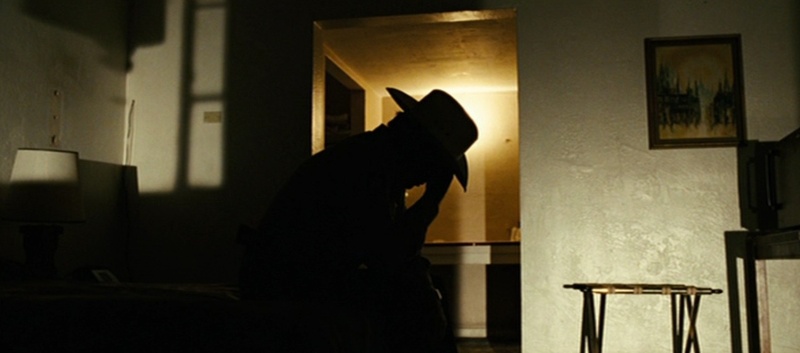
He is afraid of tapping into that inner monster.  He doesn't want to resort to violence that may be the result of him drawing his gun.  It's there within him, but he chooses to not access it.  This point is subtly reinforced when a few minutes later, the police find a bottle of milk that is still sweating on Moss' table.  Bell sits on the couch, in the exact position we saw Chigurh earlier, and the camera then cuts to his reflection in the television set.  Again, perfectly mirroring the same shot we saw with Chigurh.  The Coens seem to be suggesting that they are a reflection of each other, the other side of the same coin if you will.  

Just as Bell is not 100% honorable and brave, we see that Chigurh is not 100% evil and destructive.  When he is questioning the woman about where Moss works, and she refuses, it seems that her death is imminent.  In one scene Carson Wells (Woody Harrelson) tells Moss that even if he gives Chigurh the money, he will still kill Moss because he (Moss) inconvenienced him (Anton).  This woman is not being helpful to Chigurh, and it seems as if he will kill her for that, but we hear a toilet flush off screen and Anton walks out the door.  Later, after he is injured in the car accident, he insists the boy take $100 for his shirt, and tells the boy "You never saw me" and leaves the boys alone.

Chigurh and Bell have dominant sides (light and dark) but Moss is the mix of the two.  He coldly tells the wounded man at the beginning of the film that he doesn't have any water, and then leaves him to die.  That night, his conscience gets the better of him and he fills a plastic milk container and travels back to the crime scene in order to help the man.  That act is what dooms him.  It's not his greed, it's not his the dark side of his soul, it's his care and conscience. 

Bell is the past - Law and order

Moss is the present - greed and self serving

Chigurh is the future - dark and dangerous and bearing down with fury and might.